Pegasystems PEGACPRSA22V1 Exam Dumps Are Available At A Cheap Price
Wiki Article
DOWNLOAD the newest RealVCE PEGACPRSA22V1 copyright from Cloud Storage for free: https://drive.google.com/open?id=1SkVv_Hj8ohYpjVpeh6JfRGFMzVegJxPA
The study system of our company will provide all customers with the best study materials. If you buy the PEGACPRSA22V1 study materials of our company, you will have the right to enjoy all the PEGACPRSA22V1 study materials from our company. More importantly, there are a lot of experts in our company; the first duty of these experts is to update the study system of our company day and night for all customers. By updating the study system of the PEGACPRSA22V1 study materials, we can guarantee that our company can provide the newest information about the exam for all people. We believe that getting the newest information about the exam will help all customers pass the PEGACPRSA22V1 Exam easily. If you purchase our study materials, you will have the opportunity to get the newest information about the PEGACPRSA22V1 exam. More importantly, the updating system of our company is free for all customers. It means that you can enjoy the updating system of our company for free.
Pegasystems is a leading provider of customer engagement and digital process automation software. The company has developed a range of certifications to validate the skills and knowledge of professionals in this field. One of their key certifications is the PEGACPRSA22V1, which stands for Certified Pega Robotics System Architect 22.
Pegasystems PEGACPRSA22V1 (Certified Pega Robotics System Architect 22) Exam is a certification exam designed for professionals who are interested in building and developing robotic process automation (RPA) solutions using Pega's Robotic Automation Studio. PEGACPRSA22V1 Exam is an excellent opportunity for individuals who want to prove their skills and expertise in using Pega's RPA technology to solve business problems.
>> PEGACPRSA22V1 Authorized Certification <<
Highly-demanded PEGACPRSA22V1 Exam copyright demonstrate excellent Learning Questions - RealVCE
While buying PEGACPRSA22V1 training materials online, you may pay more attention to money safety. If you choose PEGACPRSA22V1 learning materials of us, we can ensure you that your money and account safety can be guaranteed. Since we have professional technicians check the website every day, therefore the safety can be guaranteed. In addition, PEGACPRSA22V1 Training Materials of us are high quality, they contain both questions and answers, and it’s convenient for you to check answers after practicing. We have online chat service stuff, if you have any questions about PEGACPRSA22V1 learning materials, you can have a conversion with us.
Pegasystems PEGACPRSA22V1 Exam is an essential certification test for professionals working with Pega's RPA tools. PEGACPRSA22V1 exam covers a range of topics related to RPA design and development, and passing it demonstrates a candidate's proficiency in the field. Certified Pega Robotics System Architect 22 certification is highly recommended for anyone who wants to validate their expertise in Pega's RPA tools and advance their career in this area.
Pegasystems Certified Pega Robotics System Architect 22 Sample Questions (Q94-Q99):
NEW QUESTION # 94
Which three statements describe the characteristics of unattended automations? (Choose Three)
- A. They run during pre-processing to obtain information to display on a form.
- B. They execute a fully automated task.
- C. They retrieve the next case assignment in a robotic work queue.
- D. They complete the automated tasks based on user input.
- E. They can streamline and automate portions of your case management workflow.
Answer: B,C,E
Explanation:
Comprehensive and Detailed Explanation From Pega Robotics System Exact Extract:
Unattended automations, also referred to as Robotic Process Automations (RPA), are automations that execute without human intervention. These automations operate on robotic work queues managed by Pega Robot Manager, performing background tasks automatically.
According to the Pega Robotics System Design and Implementation Guide, section "Unattended Automations (RPA) - Execution Model and Characteristics":
"Unattended automations execute robotic tasks in a fully automated manner without user interaction.
They retrieve assignments from robotic work queues in Pega Robot Manager, perform the specified automation tasks, and return results and case updates to Pega Platform.
These automations help streamline business workflows by automating repetitive tasks in back-end processes." Detailed Reasoning:
* A. They retrieve the next case assignment in a robotic work queue.
* Correct. RPA bots work from the Robot Queue (Pega's work queue) where cases are assigned for unattended processing.
* B. They execute a fully automated task.
* Correct. Unattended automations perform end-to-end automation without requiring human assistance.
* C. They can streamline and automate portions of your case management workflow.
* Correct. These automations integrate with Pega Platform cases, performing sub-tasks or full case resolutions automatically to improve efficiency.
* D. They run during pre-processing to obtain information to display on a form.
* Incorrect. That behavior describes attended automations (RDA) that assist end users in real time.
* E. They complete the automated tasks based on user input.
* Incorrect. Unattended automations operate without any user input; attended ones are triggered by user actions.
Reference:Extracted and verified from Pega Robotics System Design and Implementation Guide, Unattended Automations and Robotic Work Queue Processing section (Pega Robotics 19.1 and later).
NEW QUESTION # 95
Select the two statements that correctly describe application project items. (Choose Two)
- A. Using an application project item, users can integrate with Windows, web, or text applications that run on the client computer.
- B. An application project item orchestrates the deployment of a robotic solution and monitors the robots of the robot worker pool.
- C. An application project item integrates with Windows applications by using a self-hosted REST service through JavaScript.
- D. Application project items have accessible properties, methods, and events that launch, monitor, and expose enterprise applications for automation.
- E. An application project item is the connection point between Pega Platform and an automation.
Answer: A,D
Explanation:
Comprehensive and Detailed Explanation From Pega Robotics System Exact Extract:
An application project item in Pega Robot Studio represents an integration layer between the automation project and an external application (Windows, Web, or Text). Each project item defines how to launch, attach, and control the target application.
According to the Pega Robotics System Design and Implementation Guide, in the section "Application Project Items Overview", it states:
"An application project item defines the interaction between a robotic solution and an external application.
It provides properties, methods, and events that allow the automation to start, monitor, and control the target application.
Pega Robot Studio supports application project items for Windows, Web, and Text adapters, enabling integration with all major enterprise application types." Detailed Reasoning:
* Option A is correct because application project items are the mechanism by which Pega Robotics integrates with Windows, Web, and Text applications on the client machine.
* Option E is correct because each application project item exposes properties, methods, and events that control application behavior (for example, launch, close, monitor, or read UI data).
* Option B is incorrect - Pega Platform integration is handled through Robot Manager or Runtime API, not through application project items.
* Option C is incorrect - Application items do not use REST or JavaScript; these are specific to web connectors.
* Option D is incorrect - Deployment orchestration and robot monitoring are performed by Robot Manager, not by an application project item.
Reference:Extracted and verified from Pega Robotics System Design and Implementation Guide, Application Project Items Overview and Integration section (Pega Robotics 19.1 and later).
NEW QUESTION # 96
A developer working on an automation has added a diagnostic log component to check the following log file for information on inconsistent behavior.
Based on the image, which category and log level did the developer configure for the diagnostic log component in the automation?
- A. Category: Automation; Log Level: Warning
- B. Category: Automation; Log Level: Info
- C. Category: Adapters; Log Level: Warning
- D. Category: Adapters; Log Level: Info
Answer: C
Explanation:
The Pega Robot Studio Diagnostic Log captures runtime execution events, categorized by functional area and severity level.
Each log entry provides five primary columns:
* Type (Log Level) - Indicates severity (INFO, WARN, ERROR, etc.)
* Category - Specifies which subsystem or component produced the log (Adapters, Automation, Runtime, etc.)
* Message - Contains the diagnostic details or error description
According to the Pega Robotics System Design and Implementation Guide, section "Diagnostic Logging and Log Levels":
"The diagnostic log component allows developers to record runtime information filtered by category and severity.
Categories correspond to major system components such as Automation, Adapters, Runtime, and Windows Adapter.
Log levels include INFO, WARN, ERROR, and DEBUG.
Setting the diagnostic log component to 'Adapters' and level 'Warning' captures warnings related to adapter startup, attachment, and runtime communication." Detailed Reasoning:
From the image:
* The Type column shows: WARN (highlighted entry).
* The Category column shows: Adapters.
* The Message reads:DialogMonitorHelper.StartMonitoring: Timed out waiting 2000 milliseconds for dialog monitor to start.
This message indicates a timeout in the adapter's dialog monitoring mechanism - a typical warning-level event in the Adapter category.
Thus, the diagnostic log was configured to capture warnings for adapter-related operations.
Option Analysis:
* A. Category: Automation; Log Level: Warning - Incorrect. The message and category in the log are clearly marked under Adapters, not Automation.
* B. Category: Adapters; Log Level: Warning - Correct. The log entry explicitly shows both WARN and Adapters.
* C. Category: Automation; Log Level: Info - Incorrect. The entry's level is Warning, not Info.
* D. Category: Adapters; Log Level: Info - Incorrect. The log shows a Warning, not Info.
Final Correct answer:
B). Category: Adapters; Log Level: Warning
Reference:Extracted and verified from Pega Robotics System Design and Implementation Guide, Diagnostic Logging, Log Categories, and Log Level Configuration section (Pega Robotics 19.1 and later).
NEW QUESTION # 97
You are developing a project for a financial company that implements a branding strategy for every application and webpage used by its customers. How do you ensure consistent formatting for all toast notifications in your project?
- A. In the project explorer, click the Information icon next to the project name, and adjust the toast notification settings in the project's property grid.
- B. Add a toast notification to the Globals tab and adjust the display settings in its property grid. To add a formatted toast notification to an automation, use a Show method from the Globals section of the Palette.
- C. Create an automation setting up the toast notification properties that runs automatically before proceeding to execute the project.
- D. In the Globals tab, expand the Utilities section of the Toolbox, select the Messages section and adjust the display settings in its property grid.
Answer: B
Explanation:
Comprehensive and Detailed Explanation From Pega Robotics System Exact Extract:
In Pega Robot Studio, toast notifications are used to display short, non-blocking messages to users during runtime. These notifications are highly customizable and can be globally managed to maintain consistent branding across an enterprise automation project.
According to the Pega Robotics System Design and Implementation Guide (UI Messaging and Toast Notifications section):
"Toast notifications can be added to the Globals tab of a project to maintain consistent visual and behavioral configuration throughout the solution.
The notification element placed in Globals allows setting properties such as title, duration, color, font, and position that are shared by all automations calling the Show() method.
Automations reference the global toast notification by invoking its Show method from the Globals section of the Palette." This means that:
* The best practice for ensuring uniform design and branding (consistent colors, layout, font, and position) for toast messages is to define one global toast notification in the Globals tab.
* Once the global toast notification is configured, all automations that require displaying toast messages will simply call its Show() method, inheriting the standardized display settings.
Option Analysis:
* A. Incorrect - Adjusting the Utilities section does not define reusable toast notifications.
* B. Incorrect - The project properties do not include toast formatting controls.
* C. Incorrect - Creating an automation to set these dynamically would not enforce consistent styling across all notifications and is not recommended.
* D. Correct - Placing a toast notification in the Globals tab allows defining display parameters once and reusing them via the Show() method in automations, ensuring global consistency in branding and formatting.
Therefore, the correct and Pega-recommended approach is Option D.
References:Extracted and verified from Pega Robotics System Design and Implementation Guide, UI Messaging and Toast Notifications section (Pega Robotics 19.1 and later).
NEW QUESTION # 98
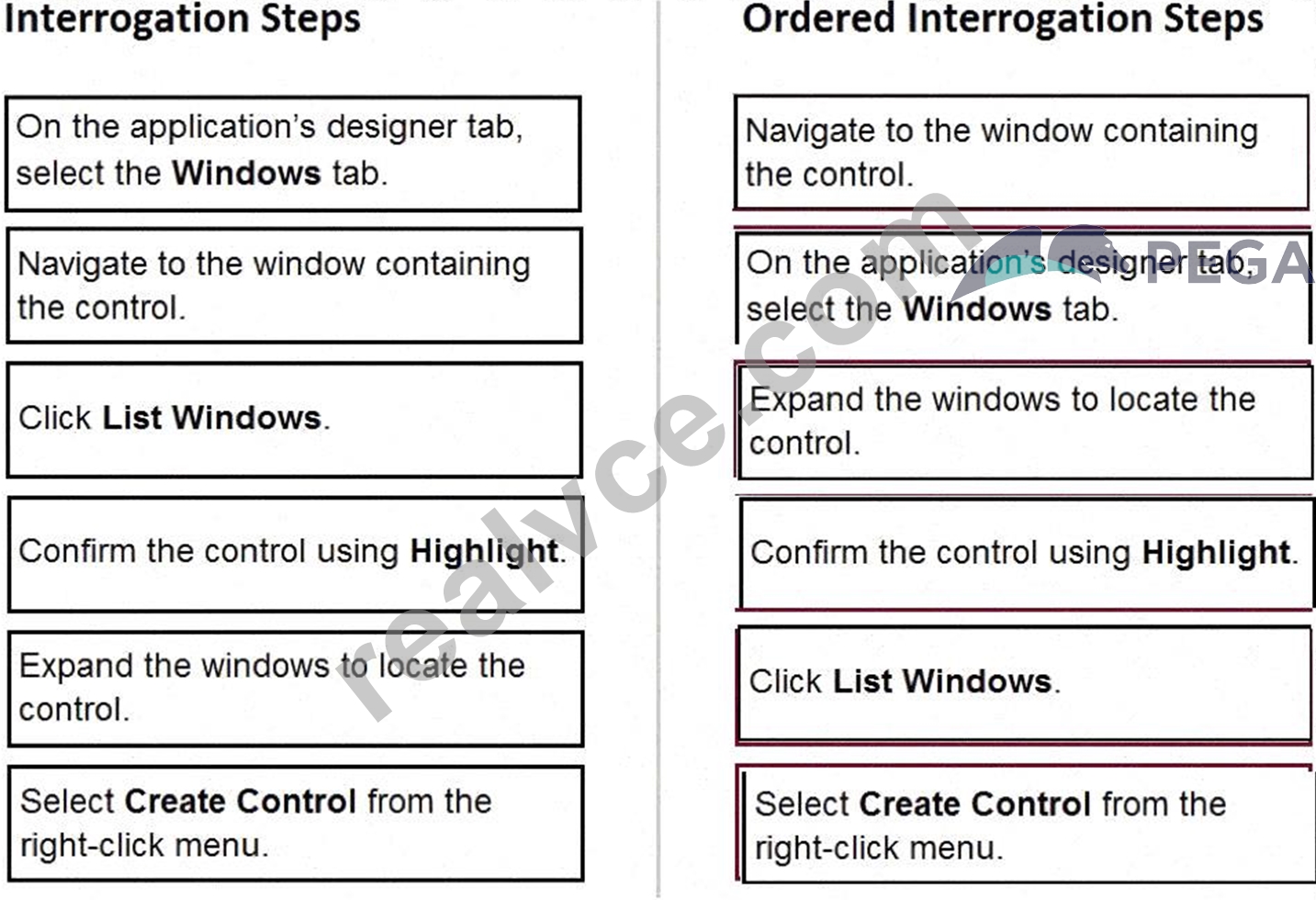
When interrogating a Windows control, the drag and drop Default interrogation method does not work. You decide to use the Create Control option to interrogate the control.
From the Interrogation Steps list, move all of the options to the Ordered Interrogation Steps column and place them in the correct order.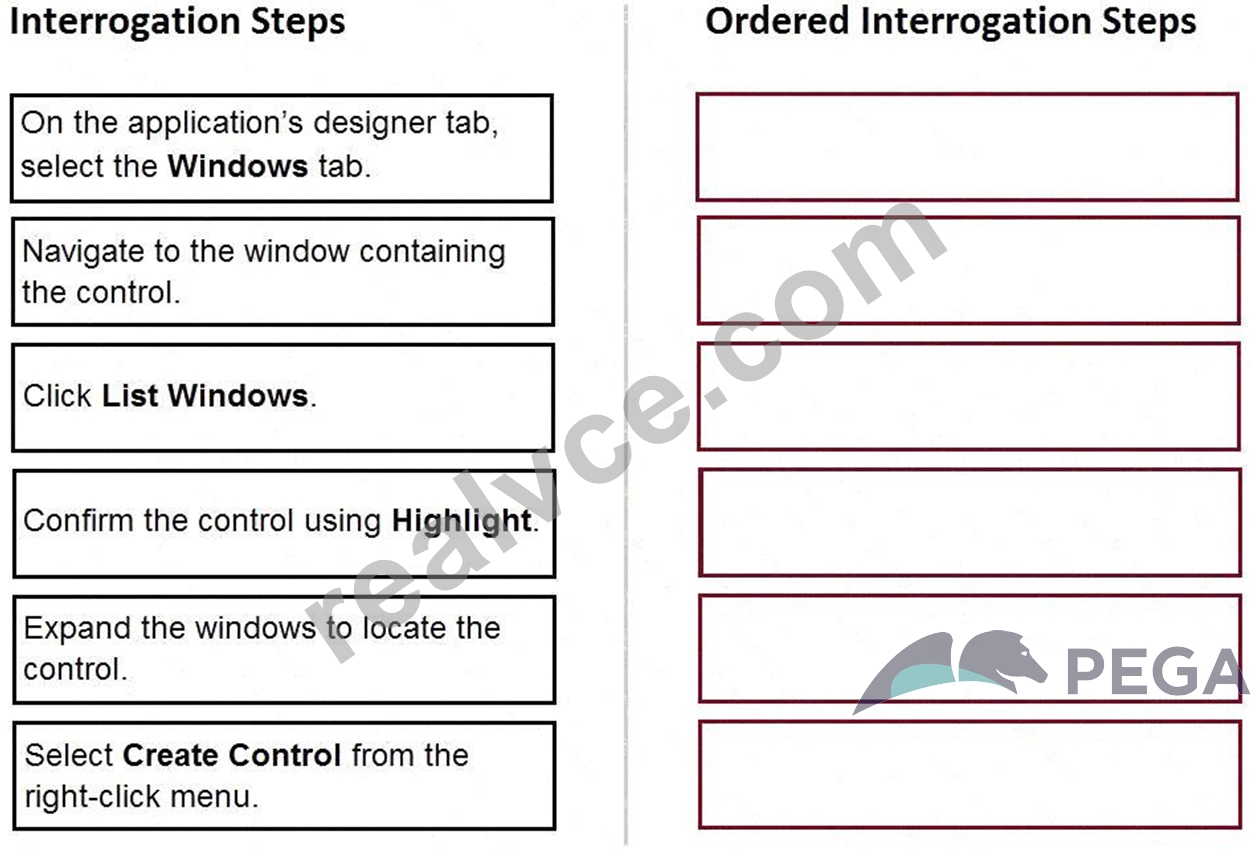
Answer:
Explanation: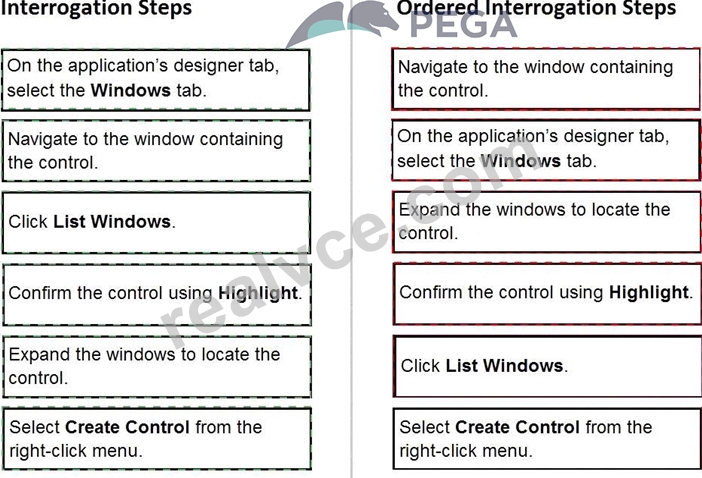
NEW QUESTION # 99
......
PEGACPRSA22V1 Latest Exam Guide: https://www.realvce.com/PEGACPRSA22V1_free-dumps.html
- PEGACPRSA22V1 Test copyright: Certified Pega Robotics System Architect 22 - PEGACPRSA22V1 Quiz Materials - PEGACPRSA22V1 Exam Torrent ✏ Search for ▷ PEGACPRSA22V1 ◁ and obtain a free download on ( www.validtorrent.com ) ????PEGACPRSA22V1 Reliable Test Book
- PEGACPRSA22V1 Reliable Exam Preparation ???? Customized PEGACPRSA22V1 Lab Simulation ???? PEGACPRSA22V1 Brain Dumps ???? ➤ www.pdfvce.com ⮘ is best website to obtain ▶ PEGACPRSA22V1 ◀ for free download ????PEGACPRSA22V1 Latest Exam
- www.pdfdumps.com Offers Free Pegasystems PEGACPRSA22V1 Questions Demo and UP To 1 year of Free Updates ✴ Search for ➥ PEGACPRSA22V1 ???? and easily obtain a free download on 《 www.pdfdumps.com 》 ????Reliable PEGACPRSA22V1 Study Materials
- 100% Pass 2026 Marvelous Pegasystems PEGACPRSA22V1: Certified Pega Robotics System Architect 22 Authorized Certification ???? Search on ➽ www.pdfvce.com ???? for [ PEGACPRSA22V1 ] to obtain exam materials for free download ⏹New PEGACPRSA22V1 Dumps
- Valid PEGACPRSA22V1 Exam Dumps ???? Valid PEGACPRSA22V1 Exam Dumps ???? New PEGACPRSA22V1 Dumps ???? ➥ www.prepawayete.com ???? is best website to obtain ⇛ PEGACPRSA22V1 ⇚ for free download ????Valid Test PEGACPRSA22V1 Test
- 100% Pass Quiz Pegasystems - PEGACPRSA22V1 - Authoritative Certified Pega Robotics System Architect 22 Authorized Certification ???? Search on ⇛ www.pdfvce.com ⇚ for 「 PEGACPRSA22V1 」 to obtain exam materials for free download ⛅Valid copyright PEGACPRSA22V1 Pdf
- Best Preparation Material For The Pegasystems PEGACPRSA22V1 Exam Questions from www.practicevce.com ???? Search for 《 PEGACPRSA22V1 》 on ✔ www.practicevce.com ️✔️ immediately to obtain a free download ⚽PEGACPRSA22V1 PDF
- New PEGACPRSA22V1 Authorized Certification Pass Certify | High-quality PEGACPRSA22V1 Latest Exam Guide: Certified Pega Robotics System Architect 22 ???? Go to website [ www.pdfvce.com ] open and search for 【 PEGACPRSA22V1 】 to download for free ????PEGACPRSA22V1 Test Pdf
- Pegasystems PEGACPRSA22V1 Questions - With 25% Discount Offer [2026] ???? Search for ⮆ PEGACPRSA22V1 ⮄ on “ www.verifieddumps.com ” immediately to obtain a free download ????Exam PEGACPRSA22V1 Bible
- PEGACPRSA22V1 Reliable Test Book ???? New PEGACPRSA22V1 Dumps ???? New PEGACPRSA22V1 Dumps ???? Immediately open ( www.pdfvce.com ) and search for ➡ PEGACPRSA22V1 ️⬅️ to obtain a free download ????Exam PEGACPRSA22V1 Bible
- www.validtorrent.com Offers Free Pegasystems PEGACPRSA22V1 Questions Demo and UP To 1 year of Free Updates ???? Open ▶ www.validtorrent.com ◀ and search for 「 PEGACPRSA22V1 」 to download exam materials for free ????Exam PEGACPRSA22V1 Bible
- janiceprfj399983.blog-a-story.com, kianallih018811.wikilima.com, wildbookmarks.com, nettieoqqo087023.blogvivi.com, laytneifm510346.slypage.com, dftsocial.com, roymtyk369539.estate-blog.com, ztndz.com, tiffanydwvh923378.bloginder.com, diegoqdrq923544.kylieblog.com, Disposable vapes
P.S. Free & New PEGACPRSA22V1 dumps are available on Google Drive shared by RealVCE: https://drive.google.com/open?id=1SkVv_Hj8ohYpjVpeh6JfRGFMzVegJxPA
Report this wiki page